
Ireland’s GDS-Index Journey
All six Irish destinations improved in the 2026 GDS-Index, and all six now rank in the world's top 40, more than any other country.
17 ViewsSince 2017, Ireland’s national GDS-Index average score has climbed from 35 to 81, while six of its destinations have built a record of continuous benchmarking and improvement.
Bailíonn brobh beart, an old Irish saying, means a straw gathers a bundle. Small things, gathered patiently, eventually add up to something significant. It is one way to describe how to build a reputation for sustainability, which is precisely what Ireland has been doing.
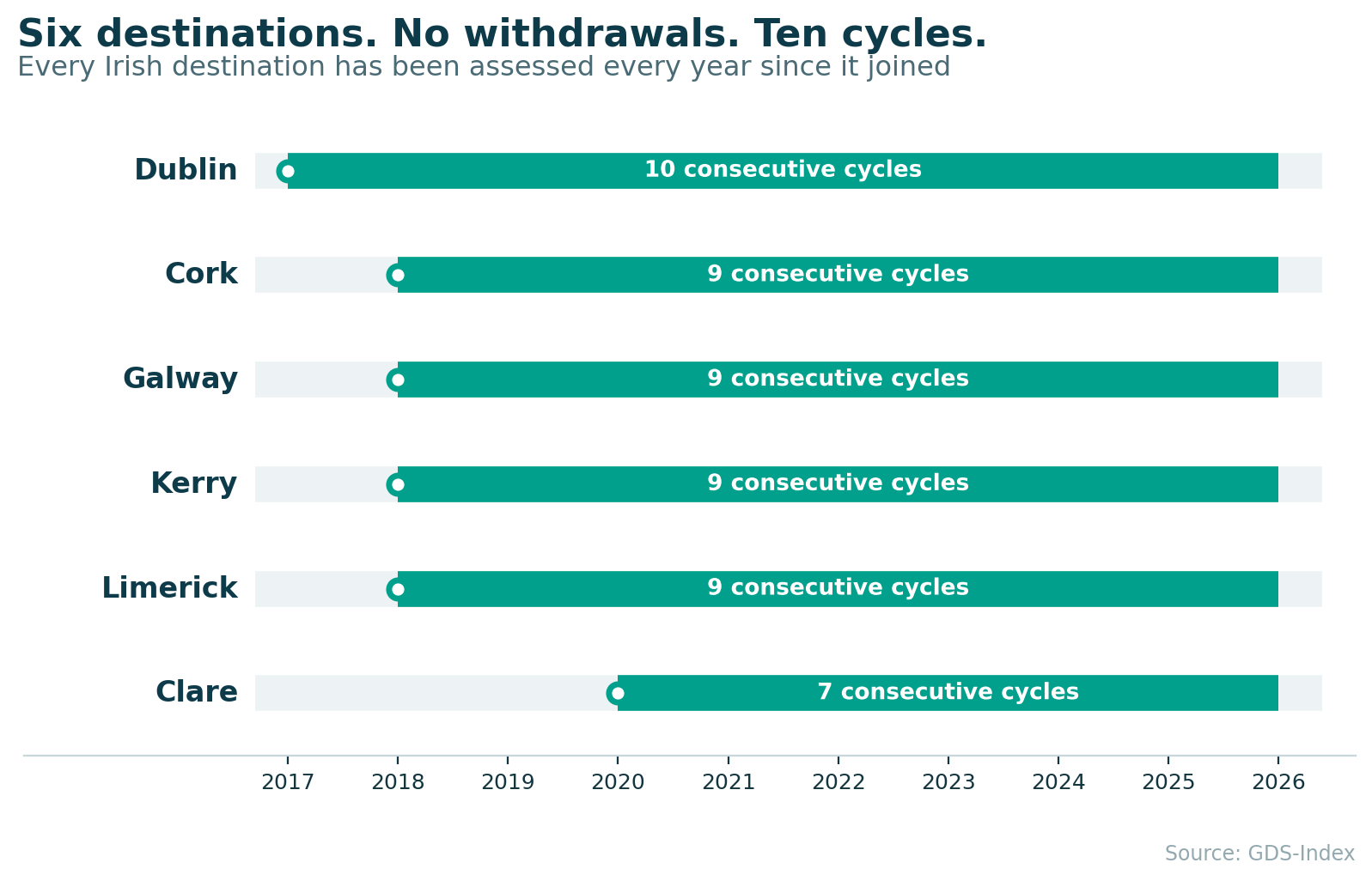
In 2020, as COVID-19 brought the business events industry to a standstill and nineteen destinations withdrew from that year’s Global Destination Sustainability Index (GDS-Index), Ireland expanded its participation. County Clare joined, taking the national cohort to six destinations, and all six have been assessed every year since. At a time when event activity was largely paused, Ireland chose to keep measuring, grow its national cohort and invest in strategic planning.
The GDS-Index is the leading international benchmarking and performance improvement program that measures the social, environmental, and regenerative sustainability of urban destinations and their visitor economies.
Dublin has now completed ten cycles; Cork, Galway, Kerry and Limerick nine cycles, and Clare seven cycles. Over that period, its national average score climbed from 35 to 81, a 46-point increase and its highest score on record.
The 2026 results reinforce that record of sustained progress. All six Irish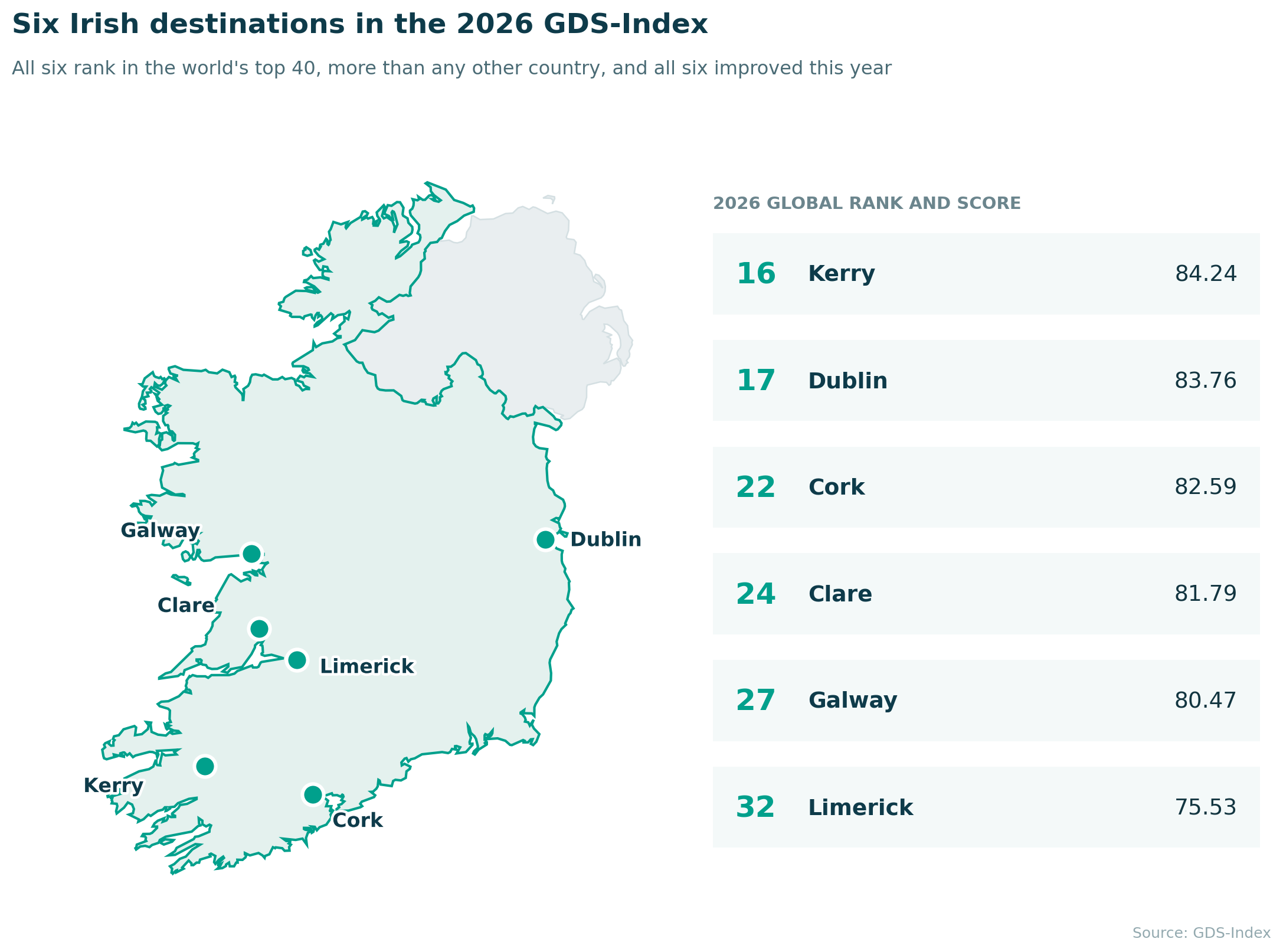 destinations improved their GDS-Index scores this year. Together, they lifted the national average from approximately 78.1 in 2025 to 81.4 in 2026, an increase of 3.3 points in a single year. Individual destination gains ranged from 1.4 points in Kerry to 4.6 points in Clare.
That continuity is the more significant story than any one year’s ranking. Twelve other countries have at some point had three or more destinations benchmarked in the same year, but most have seen participation fluctuate, decline or pause over time.
Ireland’s participation is distinct. It has built a national destination benchmarking cohort and maintained it through a pandemic, a cost crisis and ten assessment cycles. Among countries with five or more destinations benchmarked, Ireland is the only country where every destination scores above the global average, and it has the highest average across all its participating destinations. It is also the only country with a ten-cycle record which has never declined.
Participation in the GDS-Index has given Ireland a consistent international benchmark, helping destinations track progress over time, identify gaps, act on them and demonstrate improvement with credible evidence. Understanding that sustainability is a journey, not a sprint, Ireland’s advantage entering the next decade is not simply that it is seen as a leader. More importantly, it knows where the gaps are and where further progress can be made.
“Ireland has supported and led a continuous national performance improvement programme and sustained it,” says Guy Bigwood, CEO, GDS-Movement.
“Where other countries have entered several destinations at once, and collaborated in the short term, Ireland’s partnership approach demonstrates commitment, continuity and consistency. And this converts into industry impact, and systems transformation.”
This is more than a reputational achievement. It reflects a decade of destination strategies, measurement, local authority partnerships, training, and innovation. Annual benchmarking also means returning each year to test progress against the same international framework, identify weaknesses, and determine where the next work needs to happen. In practical terms, it means understanding where performance falls short, addressing those opportunities, and returning the following year ready to show what has changed.
 That improvement came as the wider benchmark was also moving. The scores required to hold positions across much of the Top 40 has increased, demonstrating how quickly performance is rising across the field.
Ireland’s progress is also spread across the country rather than concentrated in one city. Kerry ranks 16th globally in 2026, followed by Dublin at 17th, Cork at 22nd, Clare at 24th, Galway at 27th and Limerick at 32nd. Kerry also shares the lead among small cities in the Index, alongside Victoria, Canada. Further evidence that Ireland is a global leader is the fact it has more destinations in the top 40 than any other country, and every one of them improved their year on year scores.
Staying measured, year after year, across six destinations is the real achievement. It provides Ireland with something more valuable than a single ranking: a body of evidence showing where progress has been made and where further work is required.
For international business event buyers, this is proof, not promise.
Sustainability leadership is increasingly judged on evidence and sustained progress, not ambition alone. Buyers are increasingly asked to evidence the sustainability of their supply chain rather than simply describe it, and a pledge alone does not survive procurement scrutiny.
Progress is national, not concentrated in the capital: the same standard of proof is available in Kerry or Clare as in Dublin. Buyers choosing Ireland are choosing destinations that are actively measuring, benchmarking and improving their sustainability performance year after year.
With that much recorded data, Ireland has a clear view of both its strengths and its opportunities to improve, and it is acting on them.
For Ireland, environmental performance remains an important opportunity. It has moved more slowly than Social and Destination Management performance, giving the country a clear indication of where further measurement, reporting and delivery can be strengthened.
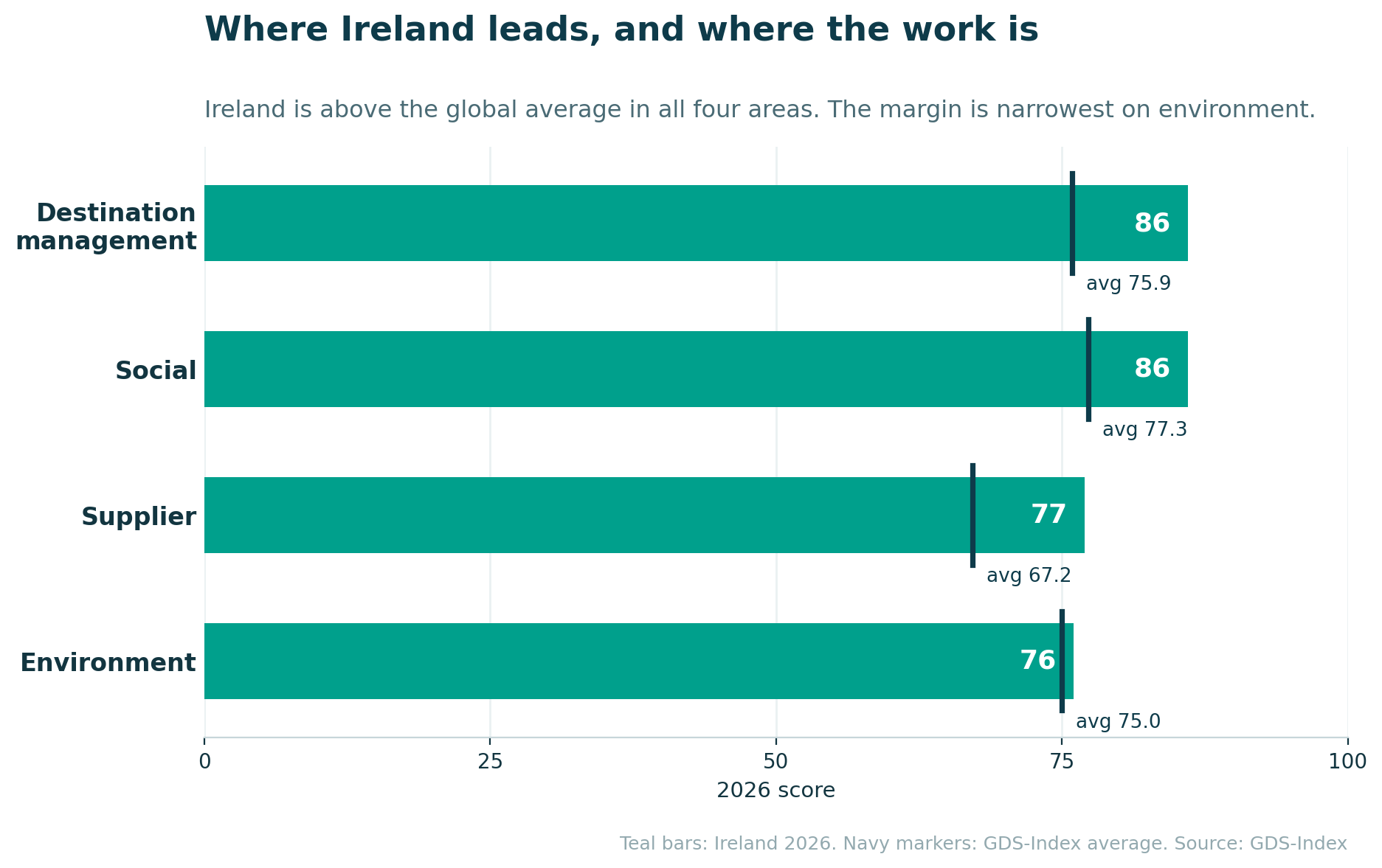
That pattern is not unique to Ireland. Across the 2026 GDS-Index, Environmental performance increased by 2.6 percentage points among returning destinations, compared with 6.2 for Destination Management and 5.1 for Supplier performance. The GDS report notes that environmental progress often depends on longer-term infrastructure, investment and policy decisions that sit partly o
utside the direct control of destination organisations.
Ireland’s next decade will require more than maintaining its position. But after ten cycles of continuous measurement, six destinations improving together and a national score that has more than doubled, it has something more valuable than a pledge: a record of progress and a clear view of the work still ahead.
Explore the full 2026 GDS-Index Report – Spark to Scale: www.gds.earth/reports