
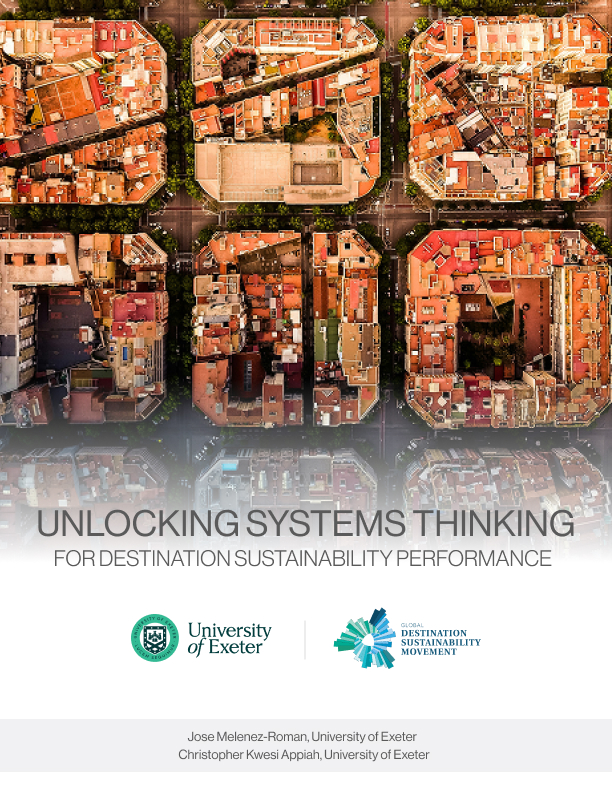
GDS-Index Systems Map | Unlocking Destination Sustainability Performance | Press Release
A new systems map transforms the GDS-Index into a strategic decision-making tool, helping destinations unlock interconnected sustainability impact at scale.
1063 ViewsThe GDS-Index systems map is redefining how destinations approach sustainability performance. More than a measurement tool, it reveals how environmental, social, supplier, and destination management actions are interconnected, helping cities prioritise what matters most and accelerate progress toward a more regenerative visitor economy.
It changes the game by visualising how GDS-Index criteria connect across entire destination ecosystems, showing how one action, like improving circular economy practices, can ripple across emissions reduction, community wellbeing, and supply chain resilience.
In this way, the GDS-Index systems map empowers destinations to move beyond fragmented efforts and toward coordinated, higher-impact action. By making interconnections visible, it helps leaders prioritise smarter investments, strengthen more robust partnerships, and accelerate regenerative outcomes to scale at a pace necessary to achieve international goals and pledges. Applied appropriately, it results in better scores and better destinations that leverage sustainability for leadership.
Get the report here.
For immediate release
Sustainable Cities Index Enhanced Through New ‘Systems Map’
19 May 2026
University of Exeter research is being used to enhance the world’s only annual sustainability tourism and events benchmark since 2025.
The GDS-Index is a trusted performance improvement programme to assess and accelerate the progress of a destination’s regenerative journey across four interconnected areas: environmental, social, supplier and destination management performance.
It measures, benchmarks, and enhances the sustainability strategies, action plans, and initiatives of approximately 100 destination management organisations, municipal authorities, and their tourism supply chains.
A dedicated mapping tool, developed by University of Exeter researchers, helps transform the GDS-Index by showing how the 76 criteria in 2024 used to measure cities’ performance, ranging from waste management to air quality and transportation, are interconnected.
The GDS-Index Systems Map shows destinations how specific actions may create knock-on effects across environmental, social, supplier and destination management areas.
This empowers cities to make more effective decisions for a more sustainable visitor economy, helping tourism organisations, their partners and supply chains to navigate trade-offs and see where their resources are best focused to make the biggest impact.
Guy Bigwood, CEO of the GDS-Movement, said: “We’re very pleased to offer this research in partnership with our esteemed academic partners at the University of Exeter. This white paper turns sustainability measurement into a powerful strategic matrix. By showing how actions connect across the system, it helps destinations prioritise effort where it can deliver the greatest, shared impact. Efficiency is key to sustainability practice, and it’s made much more manageable through this valuable work.”
Unveiled in the white paper “Unlocking systems thinking for destination sustainability performance”, the GDS-Index Systems Map is based on analysis of the GDS-Index’s criteria, sub-criteria and guidance, validated through interviews and participatory workshops with GDS-Index experts and assessors as well as tourism chiefs in Berlin, Östersund, Sapporo, Manchester, Adelaide, Bilbao, Basel, Valencia, Wrocław, Banff and Lake Louise, Washington DC, Liverpool, Gothenburg, Melbourne and Montreal.
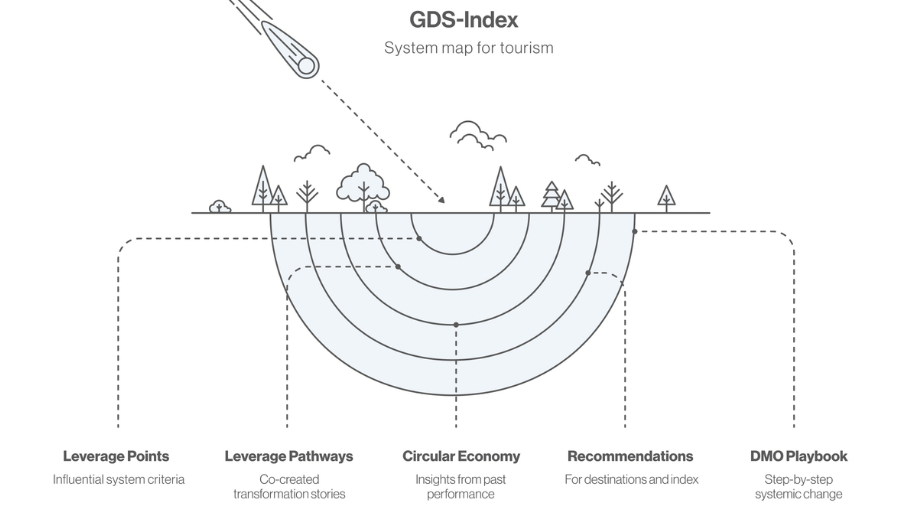
The white paper presents four practical observations for destinations that use the GDS-Index:
- Performance is interconnected
Progress in one area can influence outcomes elsewhere, helping destination management teams understand “ripple effects”, empowering their orchestrating role across the visitor economy and providing the data needed to avoid working in silos. - Prioritisation through ‘leverage points’
It identifies the most influential criteria (i.e. leverage points) in the system such as ‘Climate Action at Sector Level’ and ‘Circular Economy’, where action is most likely to support progress across multiple areas for sustainability performance. - ‘Leverage pathways’ to translate analysis into action
It introduces leverage pathways, which are practical narratives and sub-maps focused on influential criteria. Specifically, it provides step-by-step transformation narratives for Circular Economy integration, Sector-Level Climate Action, Community Engagement, and dynamic Destination Management Organisation (DMO) strategy. These are designed to support planning, stakeholder engagement, communications, and internal decision-making. - Clarifying the DMO role as convener and influencer
It explores a common tension for DMOs: being assessed against outcomes they do not directly control, like city-wide emissions or municipal waste management. The map offers a way to distinguish control from influence, and to support DMOs in convening partners and building evidence-based cases for action.
Authors Dr Jose Melenez‐Roman and Christopher Kwesi from the University of Exeter Business School said in a joint statement: “For too long, sustainability in tourism has been treated as a checklist. This research proves that performance is an ecosystem. By mapping the hidden architecture of the GDS-Index, we are giving destination leaders evidence-based tools to identify leverage points and act with greater clarity and confidence to drive systemic regeneration across their cities.”
The white paper includes a step-by-step guide with customised starting points and tailored actions for destinations at ‘Emerging’, ‘Maturing’ and ‘Advanced’ stages of their sustainability journey, outlining a four-step cycle focused on mapping control versus influence; tracing upstream and downstream effects; convening ideal stakeholders; and using learning and governance to embed change over time. This research informed the 2026 GDS-Index methodology and its findings will continue to shape future review and the GDS-Index’s ongoing support for destinations.
Unlocking systems thinking for destination sustainability performance is available to download here.