
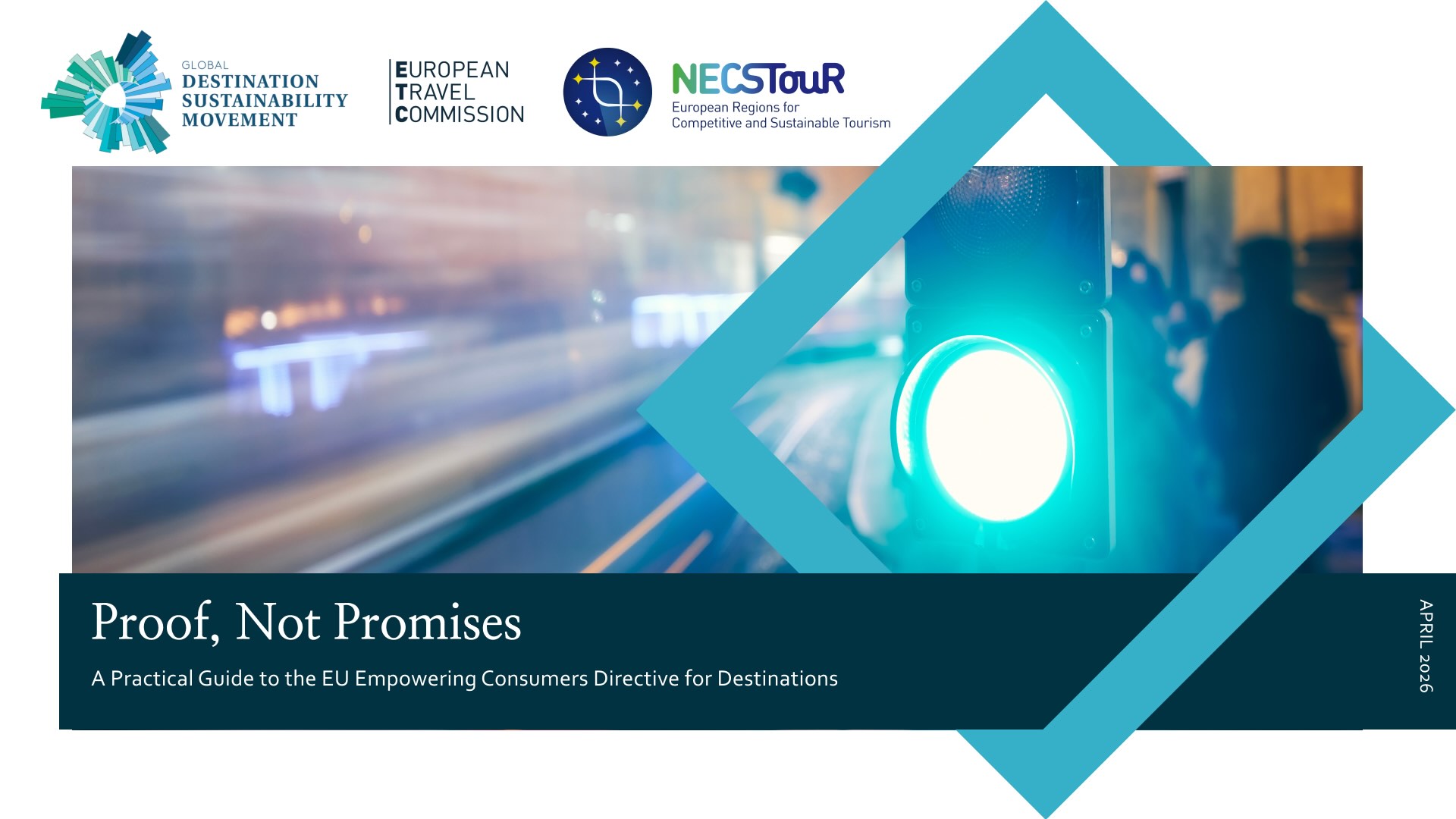
Proof Not Promises White Paper | Guiding Destinations on EU Sustainability Claims | Press Release
The Proof Not Promises report equips destinations, and event professionals, to meet new EU sustainability claims requirements with clarity, confidence, and credibility.
1046 ViewsThe Proof Not Promises report marks a turning point for destinations navigating the EU’s new sustainability claims legislation. Developed by the GDS Movement in collaboration with the European Travel Commission, and NECSTouR, this practical guide helps organisations move beyond storytelling and into evidence based sustainability communication that builds trust, reduces risk, and strengthens competitive advantage.
A Defining Moment for Destination Marketing
What happens when sustainability is no longer a narrative, but a requirement? The EU Empowering Consumers for the Green Transition Directive, coming into force on 27 September 2026, changes everything. Environmental claims must now be clear, specific, and backed by verifiable evidence across every touchpoint, from marketing copy to branding and visuals. The Proof Not Promises report exists to help you meet that moment.
Explore the full guide via www.gds.earth/white-papers/, where evidence meets action.
For immediate release
Proof, Not Promises: New Report Helps Destinations Navigate EU Sustainability Claims Law
Barcelona, 12 May 2026
The GDS-Movement, in collaboration with the European Travel Commission and NECSTouR, today launches Proof, Not Promises: A Practical Guide to the EU Empowering Consumers Directive for Destinations, a new report designed to help destinations, tourism businesses, and event organisers respond to one of the most significant regulatory shifts in sustainability communication.
The report provides practical guidance on the EU’s Empowering Consumers for the Green Transition Directive (EU) 2024/825, which will apply from 27 September 2026 and fundamentally changes how environmental claims to consumers can be made across Europe. Claims will need to be clear, specific, evidence-based, and not misleading, applying across text, visuals, labels, and branding.
A launch webinar with more than 300 registered participants marked the publication of the guide.
Guy Bigwood, CEO of the GDS-Movement, said:
“This is a defining moment for tourism and events. Sustainability is no longer just a story we tell. It is something we must prove. Organisations that invest in evidence, verification, and alignment will not only reduce risk, they will build trust and competitive advantage.”
Supporting a shift in sustainability communication
The guidance is relevant to destinations, convention bureaux, venues, event organisers, and any organisation communicating sustainability-related information to consumers.
It highlights a shift from narrative-led sustainability messaging to more evidence-based communication where claims must be supported by verifiable data and consistent internal processes. It also emphasises the need for alignment between marketing, operations, and data functions to ensure coherence in how sustainability is defined, measured, and communicated across organisations in tourism and events.
Teodora Marinska, COO of the European Travel Commission, commented:
“This Directive is an opportunity for destinations to lead with clarity and credibility. Evidence-based communication can strengthen trust, foster collaboration, and position Europe’s destinations for long-term resilience.”
John Fitzgibbon, Managing Director of NECSTouR, added:
“EmpCo reinforces the need for transparency, data, and measurable impact. For destinations, this is a shift towards more accountable and evidence-driven tourism systems.”
Practical guidance for implementation
The publication offers practical guidance to the Directive, clarifying what credible sustainability claims require in terms of evidence. It also addresses key risks, including avoiding both greenwashing and “greenhushing” caused by regulatory uncertainty.
Opportunity alongside compliance
The guide frames the Directive not only as a compliance requirement, but also as an opportunity to improve the quality, transparency and credibility of sustainability communication.
By strengthening internal evidence systems and improving consistency across functions, organisations can enhance trust with stakeholders and improve the clarity of their sustainability messaging.
Closing the capability gap
The publication identifies a wider need across the sector to strengthen data, governance and evidence capabilities. Organisations that invest in these areas are expected to be better positioned to meet regulatory expectations and improve credibility in the marketplace.
Ends
Access the report: www.gds.earth/white-papers/
About the GDS-Movement
The GDS-Movement is a pioneering, data-driven international change agency that catalyses socio-economic and environmental transformation in cities and regions worldwide. Its mission is to empower tourism and events professionals with the mindsets, skill sets, and toolsets to co-create regenerative and resilient destinations to visit, meet, and live in. Discover more at www.gds.earth.
About ETC
The European Travel Commission is a non-profit organisation representing the national tourism organisations of Europe. The 35-member tourism boards work together to build the value of tourism across diverse European destinations through cooperation in best-practice sharing, market intelligence, and promotion. See more at https://etc-corporate.org/ .
About NECSTouR
The Network of European Regions for Competitive and Sustainable Tourism is a non-profit organisation bringing together 47 Regional Tourism Authorities and DMOs and 27 academic and associated members across 18 European countries. NECSTouR develops interregional projects and fosters cooperation to enable sustainable tourism governance in Europe as a key driver of destination competitiveness. See more at https://necstour.eu/.